Hasta viniyoga
Bharatanatyam Hasta Viniyoga: The Language of Hand Gestures in Classical Dance
Introduction
Bharatanatyam, one of India's oldest and most revered classical dance forms, is a captivating blend of rhythm, expression, and storytelling. Among its many artistic elements, Hasta Viniyoga—the application and usage of hand gestures—plays a vital role in conveying meaning and emotion. Through intricate hand movements known as hastas or mudras, dancers communicate stories, depict characters, and express abstract ideas without uttering a single word.
This rich vocabulary of gestures transforms Bharatanatyam into a visual language, allowing performers to connect deeply with their audience.
What is Hasta Viniyoga?
The term Hasta means "hand," while Viniyoga refers to "application" or "usage." Together, Hasta Viniyoga signifies the various meanings and interpretations assigned to specific hand gestures in Bharatanatyam.
A single gesture can represent multiple objects, emotions, actions, or concepts depending on the context. This versatility enables dancers to create vivid narratives and nuanced expressions during performances.
Classification of Hastas
Bharatanatyam hand gestures are broadly classified into two categories:
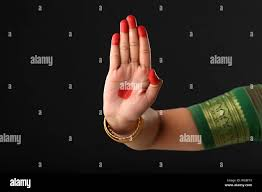
1. Asamyuta Hastas (Single-Hand Gestures)
These gestures are performed using one hand. Traditional texts describe 28 Asamyuta Hastas, each with unique meanings and applications.
Some commonly used examples include:
- Pataka – flag, cloud, forest, stopping, blessing
- Tripataka – crown, tree, arrow, flames
- Ardhapataka – leaves, knife, riverbank
- Katakamukha – holding flowers, garland, drawing a bow
- Alapadma – lotus, beauty, full bloom
2. Samyuta Hastas (Double-Hand Gestures)
These involve the use of both hands together and are often employed to depict larger objects, relationships, or symbolic concepts.
Examples include:
- Anjali – salutation, prayer, reverence
- Kapota – respect, humility
- Karkata – gathering, crowd, conch blowing
- Shankha – conch
- Chakra – discus, divine weapon
The Importance of Hasta Viniyoga in Storytelling
Bharatanatyam is not merely a dance form; it is a storytelling tradition. Through Hasta Viniyoga, dancers bring mythology, poetry, and devotion to life.
For instance, a dancer portraying Lord Krishna may use:
- Mrigashirsha to depict playing the flute,
- Tripataka to symbolize a crown adorned with peacock feathers,
- Pataka to represent flowing rivers or nature.
Similarly, emotions such as love, anger, devotion, wonder, and compassion can be effectively communicated through carefully chosen hand gestures combined with facial expressions and body movements.
Connection with Abhinaya
Hasta Viniyoga is closely linked to Abhinaya, the expressive aspect of Bharatanatyam. While facial expressions convey emotional depth, hand gestures provide clarity and detail to the narrative.
Together, they create a powerful visual experience that enables audiences to understand the story regardless of language barriers.
A skilled dancer learns not only the shape of each hasta but also its appropriate context and emotional intent.
Learning Hasta Viniyoga
Mastering Hasta Viniyoga requires patience, discipline, and regular practice. Students typically begin by learning:
- The formation of each hasta.
- The traditional meanings associated with it.
- Contextual applications in dance compositions.
- Coordination with facial expressions and body movements.
Teachers often encourage students to explore the symbolic richness of each gesture, helping them move beyond mechanical execution toward expressive storytelling.
Relevance in Modern Performances
While rooted in ancient tradition, Hasta Viniyoga remains highly relevant in contemporary Bharatanatyam. Choreographers continue to use traditional mudras while also exploring innovative interpretations to address modern themes and social issues.
This adaptability demonstrates the timeless nature of Bharatanatyam's gestural language and its ability to communicate across generations.
Conclusion
Hasta Viniyoga is the soul of Bharatanatyam's visual storytelling. More than a collection of hand positions, it is a sophisticated language that conveys emotions, ideas, and narratives with remarkable elegance. By mastering the art of hand gestures, dancers preserve a centuries-old tradition while continuing to inspire audiences around the world.
Whether you are a student, performer, or admirer of classical dance, understanding Hasta Viniyoga opens a window into the profound beauty and expressive power of Bharatanatyam.